
🚀 “Artemis-2”: Americans are set to launch for the Moon on April 1! 🌙
Artemis II: Humanity's Return to the Moon
April 1, 2026—a historic launch that will change the future of space exploration
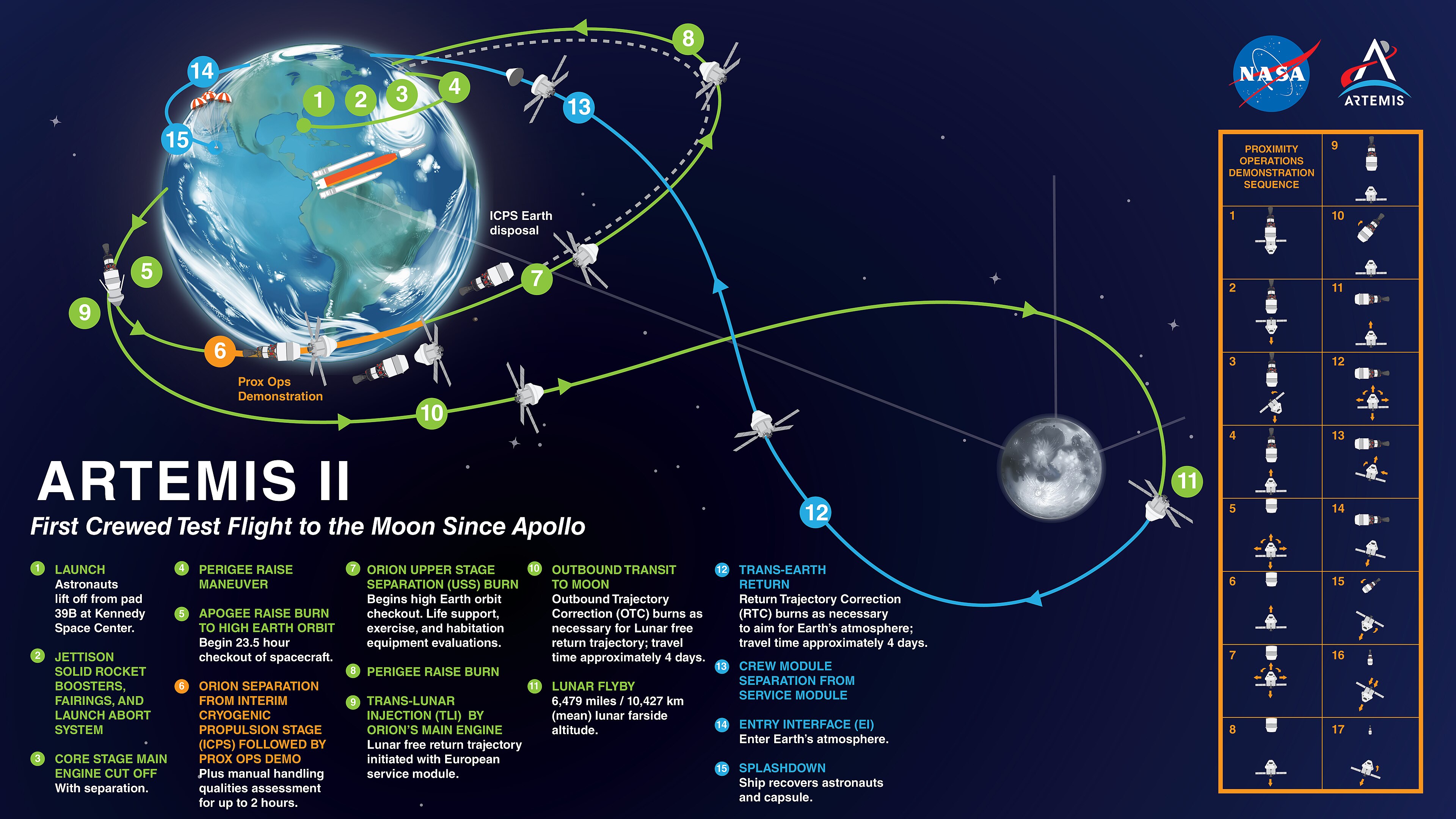
Artemis II — This isn't just a mission. It's humanity's first step toward returning to the Moon after a hiatus of more than 50 years. On April 1, 2026, a crew of four astronauts will embark on a 10-day flyby of our Moon to test key systems ahead of a future landing.
About the Artemis II Mission
Crew
Reid Weisman (commander, NASA), Victor Glover (pilot, NASA), Christina Koch (specialist, NASA) and Jeremy Hansen (CSA, Canada). This is the first international crew headed for the Moon.
Flight path
Ship Orion It will enter a near-lunar orbit, perform a gravitational maneuver, and return to Earth. Its maximum distance from Earth will be more than 400,000 km.
Systems Under Test
Life support systems, navigation, communication with Earth, the heat shield for atmospheric reentry, and software Orion—all will be tested under real-world conditions in deep space.
Significance for the Future
The success of Artemis II will pave the way for Artemis III — missions to land on the Moon, and, in the long term, to establish a lunar base Gateway and missions to Mars.
Technical Specifications
- 🚀 Launch vehicle: The Space Launch System (SLS) Block 1 is NASA's most powerful rocket, standing 98 meters tall and producing 8.8 million pounds of thrust.
- 🛸 Ship Orion: A crew of up to 4 people, a living compartment volume of 9 m³, and an autonomy of up to 21 days.
- 🔋 Power Supply: 11-kilowatt solar panels on the European Service Module (ESA).
- 📡 Communication: Live 4K stream from the ship's camera, with a signal delay of up to 2.5 seconds.
- 🛡️ Defense: The Avcoat heat shield, with a diameter of 5 m, can withstand temperatures of up to 2,760 °C during reentry.
Mission Timeline
| Stage | Time from the start | Event |
|---|---|---|
| Start | T+0 | SLS Launch from Pad LC-39B, Kennedy Space Center |
| Entry into orbit | T+18 min | Orion separates from the upper stage; the start of autonomous flight |
| Exchange Rate Adjustment | Day 2 | The first maneuver to precisely enter the lunar trajectory |
| Flyby of the Moon | Days 4–5 | Flyby at a distance of ~100 km from the surface, gravitational maneuver |
| The Return | Days 9–10 | Re-entry into the atmosphere at a speed of 11 km/s, landing in the Pacific Ocean |
Follow the mission with us
We are in Yundixords We believe that drawing inspiration from real space achievements makes our projects better. While astronauts are making history, you can follow the mission and share your thoughts with the community.
- 📺 Official broadcast: NASA+ — the launch, key milestones, and landing, all broadcast live.
- 🗨️ Discussion: channel
#spaceIn our Discord section—news, screenshots from the livestream, and technical questions. - 📊 Flight Tracker: An interactive 3D visualization of the trajectory is available in the launcher Yundixords (version 2.4+).
- 🎨 Creative Work: Post images, screenshots, and videos with the hashtag
#ArtemisYX— The best works will be featured in the project's gallery.
How do I monitor using the Yundixords launcher?
- Open the launcher Yundixords and make sure that the version is installed 2.4 or later.
- Go to the tab "Space" → «Artemis II».
- Enable the option "Display Telemetry" to display the current coordinates Orion.
- Click "Start the Live Stream" — The NASA video will open in the built-in player without ads.
- Use the button "Take a screenshot", to capture the moment and share it with the community.
No comments yet